 TGX Account
If you have been hanging around the developer community recently, the name Open Claw has definitely popped up more than once. Some say it "upended their workflow," others say "once you use it you can't go back," while some feel it's just another AI coding tool—how special could it really be?
This article isn't about hype; it's about raw capability—what Open Claw can actually do, how it fundamentally differs from the AI tools you've used, and in which scenarios it will genuinely make you think, "This is kind of insane."
First, Let's Talk About the Fundamental Difference
Most AI coding tools on the market essentially do one thing: give you suggestions while you work. You type, it watches from the side and says, "What you're about to write is probably this."
Open Claw is different. Its design logic is:
You work, it helps you
You are the main actor, the AI is the assistant. You write every line, it provides suggestions, and ultimately you decide whether to accept them.
You give the goal, it gets it done
You say "help me do this," and then go grab a coffee. It reads the code itself, breaks down tasks, writes implementations, runs tests, and submits the results.
This difference sounds simple, but it represents a completely different way of working. You are no longer "using a tool to write code," you are "assigning tasks to an Agent."
This is the watershed moment where AI coding tools evolve from "copilot" to "autopilot."
What Can It Actually Do?
Talking about a few real use cases is much more intuitive than listing a feature checklist.
Give it a Bug, and it finds, fixes, and verifies it all by itself
You only need to describe the problem or paste the error message directly into it. Open Claw will read the relevant code itself, locate the root cause, write a fix, and then run tests to confirm that no new issues were introduced. For logic-clear bugs, you don't need to watch over the entire process at all.
Build Project Structures from Scratch
Tell it what you want to do and what the tech stack is, and it can help you build the project skeleton—directory structure, basic configuration, and initial implementation of core modules. Instead of generating a bunch of code that you still have to organize manually, it writes directly into the repository.
Cross-File and Cross-Module Refactoring
This is where it is an order of magnitude stronger than single-file AI tools. Open Claw can understand the structure of the entire repository, track cross-file dependencies, and complete tasks like "if you change A, you need to synchronously update B and C," and after changing, it can run tests itself to confirm that other parts weren't broken.
Automatically Write Tests
Give it existing code and have it complete unit tests or integration tests. It can understand the intent of the code and generate test cases covering major logical paths, rather than that kind of formalism testing that "passes but has no practical meaning."
Understand Unfamiliar Codebases and Work on Top of Them
When taking over an unfamiliar project, Open Claw can read the repository by itself first, understand the architecture and core logic, and then complete the tasks you assign to it on this basis. There is no need for you to write a detailed project document for it first.
What is the relationship between Open Claw and GitHub?
Open Claw is not a standalone tool; its entire workflow is built on top of GitHub.
This is not just a "you need to log in to GitHub" kind of connection. It uses GitHub permissions to read your code, uses a GitHub identity to submit modifications, and triggers GitHub Actions to run automated tests. The core credential for it to continue working in an unattended state is something called a Personal Access Token.
In other words, a GitHub account is the foundation for Open Claw to run. If the account is configured well, it can work stably; if the account quality is poor, the entire automation process will frequently encounter issues.
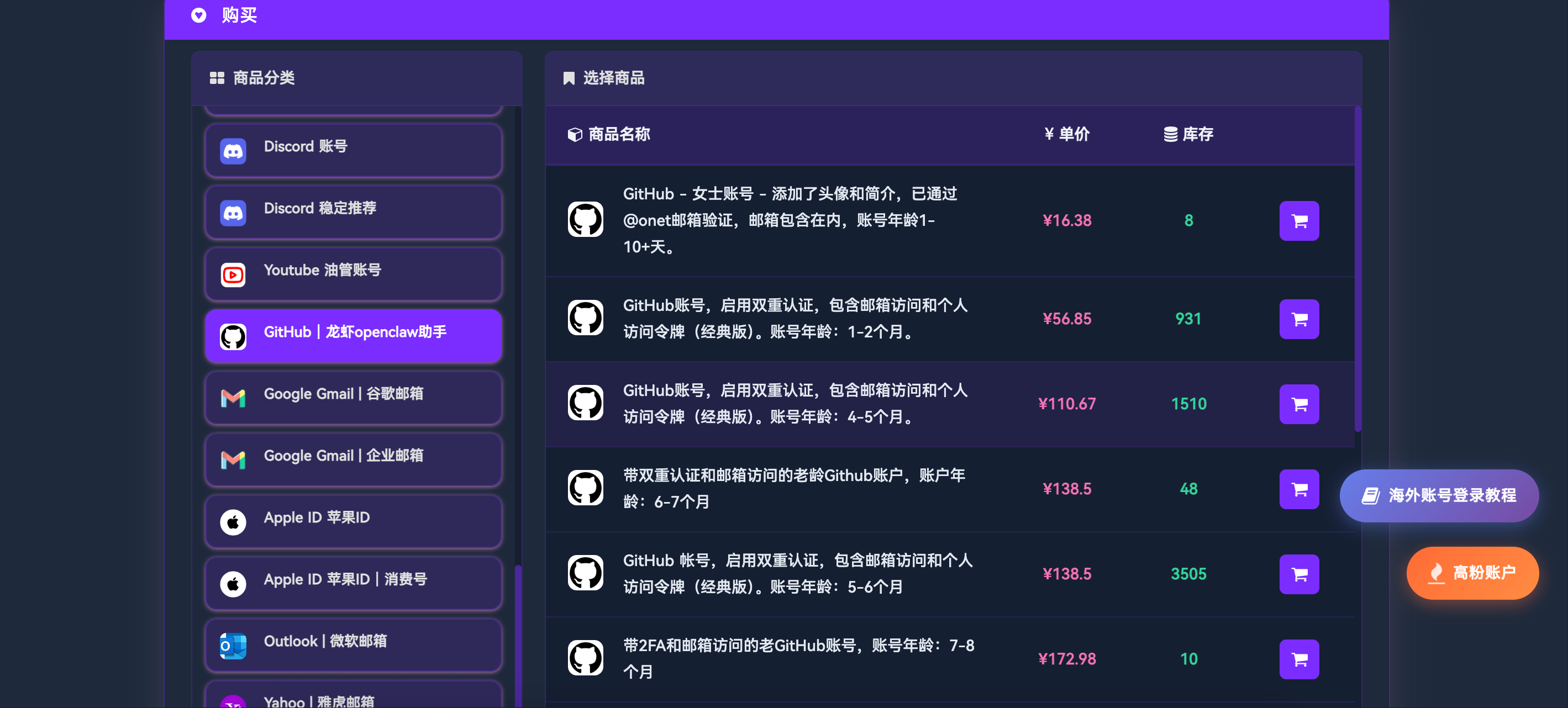
💡 If you plan to seriously use Open Claw to run continuous tasks, an aged account with 2FA enabled, email access, and a Classic PAT will be much more stable than a newly registered account—GitHub has more lenient API call restrictions for aged accounts and a lower probability of triggering security reviews. TGX Account offers a variety of GitHub accounts of different ages to choose from, feel free to check it out if needed.
We must also be clear about its limitations
Open Claw is very powerful, but it is not a silver bullet. Here are some boundaries you will actually encounter when using it:
Complex business logic still requires humans
In scenarios involving specific business rules, domain knowledge, or highly customized requirements, its performance will drop noticeably. It does not understand your business and requires you to provide sufficiently clear context or manually review its output.
The clearer the task description, the better the result
Giving it a description like "Help me optimize this project" will leave you disappointed. With a description like "Help me change the database query in user-service from synchronous to asynchronous while keeping the original interface unchanged," it does a great job. Vague input yields vague output—it's just like working with people.
It makes mistakes and needs your review
The code generated by Open Claw is not 100% reliable, especially when it comes to edge cases and exception handling. Treating it as a highly efficient collaborator that requires a Code Review, rather than a completely trusted black box, is a more rational approach to using it.
Is it worth using?
The answer to this question depends on your current working model.
If you spend most of your time writing repetitive code, doing routine bug fixes, and maintaining a project of a certain scale—Open Claw can significantly compress the time cost of these tasks.
If you are working on highly creative design, cutting-edge technical exploration, or business logic that requires deep domain knowledge—it is more of an assistant than a replacement.
But one thing is certain: the direction represented by these Agent tools is real, and the upper limit of AI programming is being redefined. Open Claw's current state is already good enough to make it worth a serious try.
📌 About TGX Account One-Stop Global Account Purchase
Providing multi-platform accounts such as GitHub, Twitter, Instagram, and Threads, stably operated for over 2 years, supporting both retail and wholesale.
📩 Official Website: https://www.tgxaccount.com?from=2462
💁♀️ Telegram: https://t.me/tgxaccount_bot
❓ FAQ
Frequently asked questions about Open Claw's capabilities and usage scenarios.